FGV 2026 (Vestibular 2026/2 · Administração · 1ª fase) · questão 37
Questão 37 FGV 2026 · Vestibular 2026/2 · Administração · 1ª fase: Interpretação de texto
Texto para responder às próximas três questões
LISZTOMANIA: FOR THE LOVE OF MUSIC
By Megan Szostak
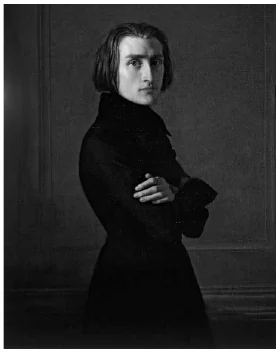
Franz Liszt, oil on canvas by Henri Lehmann, 1840; in the Carnavalet Museum, Paris.
(Historical Note: 19th-century Hungarian pianist and composer Franz Liszt is widely considered the first "rock star" due to the extreme, hysterical adoration of his fans – a phenomenon known as “Lisztomania " – which included fainting, fighting over his discarded gloves, and tearing at his clothing.)
Growing up, I hated music. I had been exposed to the popular music of the early 2000s before anything else, and if you can remember the Miley Cyrus hits or other millennial-teen music that permeated through the public-school system and into the ears of impressionable youth during that era [época], my original sentiments towards music will seem justified. After spending nearly eight years believing that I would live a life without melody, I discovered classical music. Suddenly, I didn’t feel as though the performer was force-feeding a message to me through shallow lyrics but rather was giving me an opportunity to interpret the melodies as I pleased. The complexity of classical music enchanted me, and the breadth [amplitude] of styles gave me insight into the scope of human musical production, which spanned so far beyond Britney Spears. This revelation led to the biggest paradigm shift I have ever experienced: I discovered that my life would never be complete without music. Lisztomania had taken possession of me.
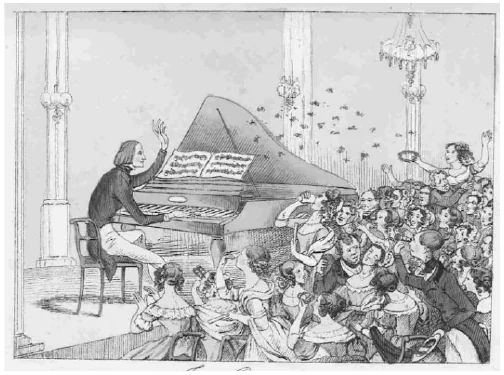
An 1842 cartoon by Theodor Hosemann showing 'Lisztomania', the hysteria of the audience when the virtuoso piano player and composer Franz Liszt (1811-1886) performed in public.
The term was inspired by the phenomenon of the brilliant Hungarian composer and piano virtuoso Franz Liszt. Just as the Beatles and Beatlemania took fans by storm [conquistaram os fãs de forma súbita e avassaladora] in the 1960s, Liszt provoked a similar sensation over a century earlier. When he was on a concert tour of Europe in the 1840s, women went wild, some fainting during the performances of the young, rugged [de visual viril e charmoso] pianist, others trying to cut locks [mechas] of his hair. To describe this behavior, German journalist Heinrich Heine coined the term “Lisztomania.” And doctors of that time began treating Lisztomania not only as an intense passion for Franz Liszt himself, but also as an insatiable love of music. And that double meaning has survived to this day. I am proof of that.
Adapted from The Tufts Daily, February 5, 2019
By ending her article with the sentence “I am proof of that,” the author is most likely
- Adeclaring her intense and enduring attachment to a man and to music.
- Breaffirming her belief that no musicians, not even the Beatles, have ever been as successful and innovative as Franz Liszt.
- Creaffirming her belief that the existence of Lisztomania cannot be denied.
- Ddeclaring that no music can possibly offer the subtlety, richness, and beauty of classical music.
- Edeclaring that her love of classical music led her to a love of Liszt’s music, not vice versa.