FGV 2026 (Vestibular 2026/1 · Administração · 1ª fase) · questão 37
Questão 37 FGV 2026 · Vestibular 2026/1 · Administração · 1ª fase: Interpretação de texto
Texto para responder às próximas três questões.
TOO CLOSE FOR COMFORT
By Kati Moore
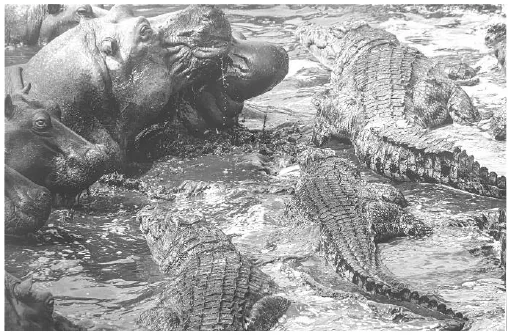
(Photograph By Art Wolfe)
When the dry season comes to Katavi National Park in Tanzania, the Ikuu River starts to shrink to a series of disconnected pools along the river bed. Hippos (Hippopotamus amphibius), lacking sweat glands, congregate by the hundreds in these pools to stay cool.
Photographer Art Wolfe was visiting the park toward the end of the dry season to photograph an eclipse when he came across this scene. In a semi-arid acacia forest, about a hundred hippos crowded into a pool roughly fifty yards [cerca de 46 metros] long and twenty-five yards [cerca de 23 metros] wide. About a half mile down river there was another pool of a hundred or so hippos.
A group of Nile crocodiles (Crocodylus niloticus) moving downstream encountered the hippos. Though crocodiles mainly eat fish, they will sometimes attack other prey [presa], including small hippos. Hippos, however, can weigh more than 3,000 pounds [1.360 quilos], and adults will fight back. Wolfe watched from his vantage point on a bank [margem] above the pool as one of the passing crocodiles got too close to a hippo, and the hippo took a snap at it [deu um bote nele]. The crocodile managed to escape, though it appeared to be wounded.
Hippos and crocodiles usually tend to avoid each other– hippos stick to the water and crocodiles sun themselves on the river banks. “It was just sheer luck that all those imposing creatures were all together in the same pond,” Wolfe said. “It was a dramatic moment.”
Adapted from Natural History, July/August 2022
The passage supplies information that would most likely answer the following question:
- AWhat is one biological reason that hippos congregate in pools of water in Katavi National Park during the dry season?
- BWhy does the hippo population in Katavi National Park increase during the dry season?
- CDuring which months of the year are Nile crocodiles especially attracted to the Ikuu River?
- DWhy do hippos always congregate in separate groups of more or less 100 during the dry season in Katavi National Park?
- EWhy are Nile crocodiles more likely to attack baby hippos during the dry season than during other times of the year in Katavi National Park?